
Quincy Recycle Employee Spotlight: Carrie Potter
There isn’t too much that gets us more excited than getting to talk about recycling. But, the chance to spotlight one of our amazing employees is definitely at the top of that list. Meet Carrie Potter.

Carrie has been with Quincy Recycle since 2009 and currently serves as a Safety and HR Coordinator at the corporate office in Quincy, IL. She lives and breathes our company’s core values. And, while it’s difficult to pick just one to talk about, the leadership team here at Quincy Recycle nominated Carrie for her commitment to our first core value: Alive and Well.
Quincy Recycle’s Core Values






Alive and Well is all about the safety and well-being of our employees. A safe work environment is extremely important to us here at Quincy Recycle and what “safe” looks like has changed a lot over the last few months as the coronavirus pandemic has swept the globe. Without hesitation, Carrie has stepped up and taken an active role in managing the PPE (Personal Protective Equipment) supply chain for all of our plants.
“Currently with COVID-19, there is a greater need for supplies to keep the plants clean and more PPE is required. These supplies are not easy to find right now. Carrie stays on top of the orders and if she is not confident a vendor will ship in time, she will find another avenue.” – Joe Genenbacher (Purchasing, Maintanence and Safety Manager at Quincy Recycle)
We sat down with Carrie to learn a bit more about her and her tenure at Quincy Recycle.
What does a typical day at work look like for you?
I start my day looking through emails and adding new tasks to my list. From there, I may be working on numerous tasks: ordering supplies, payroll, sending safety-related emails, working with employees on benefits… every day is always different.
What is your favorite part about working for Quincy Recycle?
My favorite part about working at Quincy Recycle is how much it has grown! It’s a great testimony to how hard our team works and adapts to change.
How would you describe the culture at Quincy Recycle?
The culture at Quincy Recycle is positive and supportive. We wear many hats and working with co-workers has always been a positive experience. It’s a blessing to work with a team that acts and feels like a family.
When you’re not at work, how would we find you spending your free time?
You’ll find me hanging with my kids and husband. Playing Barbies/dinosaurs, riding bikes, and reading books are some of our favorite activities. My husband and I enjoy gardening and cooking and usually have a yard or house project in the works.
What’s one thing you’d like prospective employees to know about the company?
Prospective employees should know what an innovative company we are. Quincy Recycle is always striving to improve processes, be more efficient, and is always ready to adapt and grow. It’s phenomenal how versatile we are!
We are a family here at Quincy Recycle and keeping our family safe is at the top of our priority list.
The entire team is extremely proud of and grateful for Carrie and her commitment to the health and safety of everyone at Quincy Recycle. She truly wants everyone to be Alive and Well.
“Carrie is a go-getter and genuinely cares about the people she works with. You can see this in her loyalty and commitment to the company. You won’t find anyone who wouldn’t say this same thing about her!” – Laurie Gilbert (Human Resource Manager, Quincy Recycle)
Creating a strong and positive culture is something we’ve put a lot of work into over the years. It’s why we established our core values, which we hold near and dear. Everyone at Quincy Recycle is committed to living our core values every day. We may be in the recycling business, but we’re also in the people business and we think our people are the best around! Be on the lookout for future employee spotlights. We can’t wait to show off more of the team!
Are you interested in learning more about Quincy Recycle?
Check out our About Us page for company background and our Careers page for information on how to join our team.
Don’t forget to subscribe to our blog for the latest in industry news, recycling trends, and more!

Employee Spotlight: Kelsey Hayes
Kelsey Hayes truly owns her role as our Financial Controller and the respective scope of responsibilities she and her team share in ensuring the accuracy of our financial data and the integrity of our processes and transactions. She has a thirst for knowledge and understanding in all aspects of our business, and she is committed to learning and continuous improvement. In the 18 plus months that she has been our Financial Controller, Kelsey has built a strong, balanced, and dynamic team where voices are heard, strengths are leveraged, and internal controls are protected. Phil Hildebrand said of her, “Kelsey’s determination, sense of urgency, and high orientation for detail give me confidence that our team is on top of the day-to-day activities with a focus on making it easy for our vendors and our customers to do business with us.”
When did you start with Quincy Recycle?
July 2017
What was your job title when you started?
Financial Accountant
What is your current title?
Financial Controller
If you had to pick one, which Core Value is your favorite and why?
Alive & Well. Safety is the top priority at Quincy Recycle but this core value also represents work-life balance. I am happy to work for a company that values me as a person and wants to see me succeed in all facets of life.
What was the most challenging thing to learn in your roles?
Learning a new accounting system and the recycling industry in general was challenging during my first few years at Quincy Recycle. As my role has changed over the last 6 years, I have been continually challenged in new ways and never know when a new learning moment will arise.
What was the most surprising or fun thing to learn?
I am constantly amazed by the amount of companies Quincy Recycle works with. I think it is fascinating to walk into a store and recognize companies/brands of products on the shelves that I have worked with in my role at QRP.
What’s your favorite part about working at Quincy Recycle?
The people and the ability for unlimited growth.
What would you like prospective employees to know about Quincy Recycle?
Hard work does not go unnoticed at Quincy Recycle. If you put in the time, effort, and energy, you will realize great things at this company.
What are some of your hobbies outside of work?
Spoiling my 8 nieces & nephews, playing volleyball year-round, and traveling! My husband and I are going on an Alaskan cruise this Summer!
What’s the best piece of advice you’ve ever read or received?
Keep the mentality “If it is to be, it is up to me”. If you want something in life, you are the only one that can make it happen!
If you had to pick a song to portray the culture of Quincy Recycle, what would it be and why?
“We Are Family” by Sister Sledge

How Quincy Recycle Fits Into Your Circular Economy Plan
In recent years, the circular economy concept has gained significant traction.
But what exactly does it mean? At its core, a circular economy seeks to shift from the traditional linear “take-make-dispose” approach to a more sustainable model based on recycling, reusing, and reducing waste. A circular shift requires businesses to rethink their current practices and look for ways to improve sustainability goals.
In this blog, we’ll shed light on how Quincy Recycle can be your trusted partner in achieving your circular economy plan.
Waste Reduction Through Material Recovery
Millions of tons of reusable materials end up in landfills every year. Quincy Recycle is dedicated to sourcing and collecting these materials before they go to waste.
Through advanced material recovery techniques, we help identify recyclable materials within your waste stream and recover them. Our team works with customers to collect various types of plastic, metal, paper, cardboard, and other materials for repurposing or reuse. We work with national partners in a circular approach to ensure that valuable resources are extracted and reintegrated into the supply chain.
Overall, material recovery helps businesses reduce their waste output, save on landfill fees, and optimize the use of resources.
Sustainable Resource Management with Industrial Symbiosis
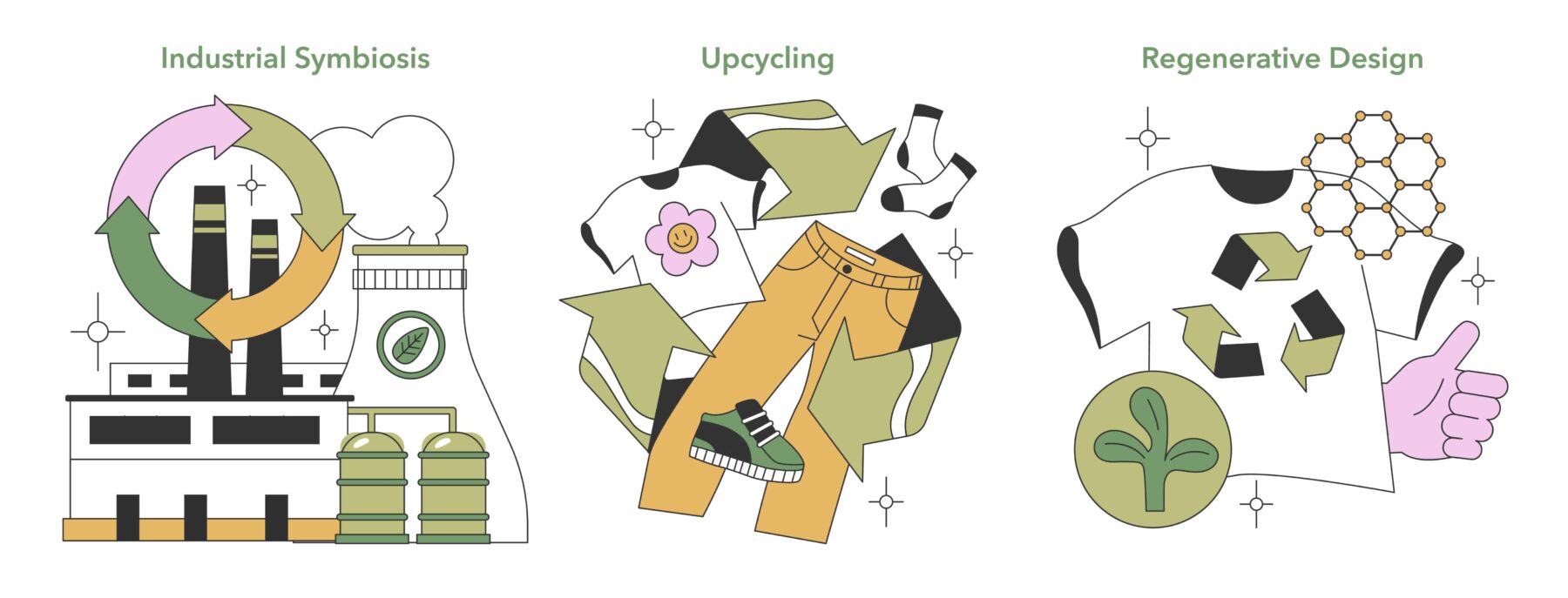
Industrial symbiosis offers a unique opportunity for businesses to exchange and utilize each other’s waste as valuable resources. Quincy Recycle contributes to industrial symbiosis in a circular economy by connecting and collaborating with different industries.
For example, imagine a plastic manufacturing company generating a significant amount of waste in their process. Instead of disposing of the waste, Quincy Recycle identifies a symbiotic opportunity by connecting the plastic manufacturer with another company needing plastic raw materials, such as a packaging company.
We then facilitate the transfer of plastic waste to the packaging company, which uses it as a valuable resource to produce new packaging materials. Multi-company collaboration allows the plastic manufacturer to reduce waste and disposal costs and enables the packaging company to obtain cost-effective raw materials.
Our industrial symbiotic relationships help businesses close the loop in their production cycles. Waste from one industry becomes a valuable resource for another, and everyone involved becomes part of a more sustainable circular economy.
Protecting Your Image and the Bottom Line
Circular economy plans can promote a business’s reputation and brand image as an environmentally responsible entity. In an increasingly conscious marketplace, consumers and stakeholders demand sustainable practices and are more likely to support businesses prioritizing environmental stewardship. Working with a reputable recycling partner like Quincy Recycle allows businesses to strengthen their brand value and differentiate themselves from competitors.
Implementing a circular economy plan with Quincy Recycle can also bring economic benefits. Businesses can efficiently manage their waste streams, minimize disposal and hauling costs, and potentially generate additional revenue by selling recycled materials or by-products.
Why Work with Quincy Recycle on a Circular Economy Plan?
We offer customized solutions and recycling expertise to meet your needs, such as:
1. Material Evaluation
Quincy Recycle has a team of recycling experts who can evaluate your waste streams and design tailored recycling solutions for your organization. We understand the unique challenges different industries face and can guide you in optimizing your recycling processes.
2. Comprehensive Recycling Services
Whether you need assistance with single-stream recycling, document destruction, or specialized recycling of specific industrial materials, Quincy Recycle has you covered. We offer a wide range of recycling services to meet your needs and help you focus on your core business operations.
3. Transparent Reporting
We believe in transparency. You will receive detailed reporting on the volumes and types of materials collected, suggestions on waste stream management, and updates on how to continue achieving your circular economy goals.
4. Long-Term Collaboration
Lasting relationships with our partners are a driving force behind what we do. We are committed to continuously improving our recycling services and working closely with you to meet your circular economy goals. Our dedicated team of recycling experts will be with you every step of the way.
Are you interested in creating a Sustainability Plan? We can help.
We have helped industrial and manufacturing companies make a positive impact on the future of our planet. From waste reduction and cost savings to promoting sustainable supply chains and environmental stewardship, we have the expertise and resources to help you achieve your circular economy goals.
Contact Quincy Recycle today at 800.311.6097 and let us be your trusted partner in industrial recycling. Together, we can create a more sustainable future for generations to come.

Employee Spotlight: Kyle Howell
When our leaders embody our Core Values, they help lift up everyone around them. That is certainly the case with Kyle Howell. He is a shining example of putting the values front and center. General Manager Michael Malloy says of Kyle, “He has grown with Quincy Recycle from a shift supervisor to Operations manager because of his hard work, determination to win and his continuous dedication to learning. He has built a great team around him and is always focused on our core values. ” Thank you for continuing to be a great example, Kyle!
When did you start with Quincy Recycle?
May 2021
What was your job title when you started?
Plant Supervisor
What is your current title?
Operations Manager
If you had to pick one, which Core Value is your favorite and why?
Alive & Well Being in operations the biggest win I can have every day is getting my team home safe to their families. I can’t just talk safety; I need to live it through my actions.
What was the most challenging thing to learn in your roles?
Managing the person and not the job. Every person needs managed in the way that will help them succeed.
What was the most surprising or fun thing to learn?
Marketing material has been a challenging but fun thing to learn. Connecting with other people that want to provide sustainability has helped my team provide the best waste management solutions to our vendors.
What’s your favorite part about working at Quincy Recycle?
Being able to teach people about the benefits of recycling and coaching them on the best ways to provide sustainability to their business.
What would you like prospective employees to know about Quincy Recycle?
We treat our team members like people, not numbers. We genuinely want people to succeed and work diligently to help them to achieve their goals.
What are some of your hobbies outside of work?
I enjoy being outdoors and spending time with my friends and family. I’ve picked up golfing the last few years and enjoy the challenges that come with it. I will occasionally play recreational baseball and ice hockey when available.
What’s the best piece of advice you’ve ever read or received?
Stop saying you don’t have time and start saying it’s not a priority. You will make time for things that are a priority. If someone says they don’t have time what I hear is it’s not a big enough priority yet.
If you had to pick a song to portray the culture of Quincy Recycle, what would it be and why?
Avicii- The Nights. Make a positive impact everywhere you go. Live life to the fullest and live a life people will remember!!