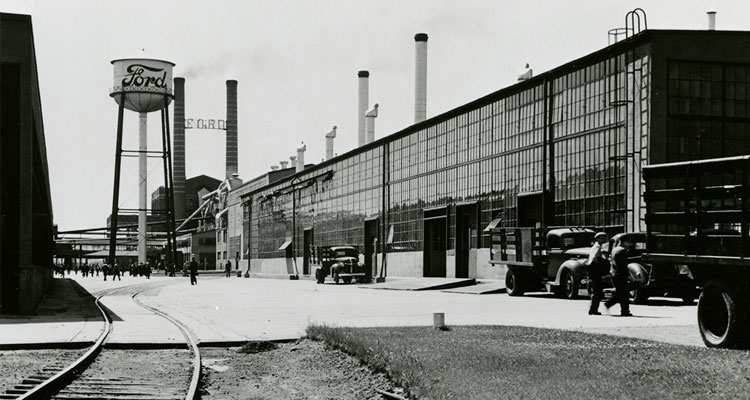
Exterior historical view of a Ford manufacturing facility.

Think Waste

Henry Ford hated waste. Whether it was wasted time, energy, activity, or materials, Ford wanted to eliminate waste from his organization.

He also expected his employees to be on the lookout for waste in all its forms. Wherever there was excess material wasted, Ford wanted to identify it, and either eliminate the waste or find a way to get paid for it.

How effective was Ford at this? According to Industry Week, “Distillation of waste wood into methyl alcohol, Kingsford charcoal, and other chemical products brought in $12,000 dollars a day, or enough to pay 2,000 workers $6 a day…”. This at a time when a loaf of bread cost a dime!

Oh, and Kingsford Charcoal? It was originally called Ford Charcoal…

Henry Ford saw that he was generating incredible amounts of wood scraps, and being Ford, learned how to turn those scraps into charcoal briquettes… so he build a plant, and a new company.

Quincy Recycle follows a similar model… we work with manufacturers to learn were waste is creating problems for them, and then we work to solve those problems. Often we’re able to divert waste from expensive landfills and instead generate a revenue stream for manufacturers.

Have you looked at your waste stream lately?

Contact us using the form to the right, or call 800-311-6097 to get started looking at waste in a new way.

A Plant Manager’s Guide to Plastic Waste Streams

A Plant Manager’s Guide to Plastic Waste Streams

Plastic waste is one of the more complicated parts of running a manufacturing facility. Unlike cardboard or clean metal scrap, plastic comes in dozens of resin types, each with different recycling requirements, different market values, and different handling considerations. What gets recycled, what gets landfilled, and what can actually generate revenue depends heavily on knowing what you have and how to manage it.

This guide is intended to give plant managers a clearer picture of how industrial plastic waste streams work, what factors affect recyclability and value, and how to build a more efficient process around the plastic scrap your facility generates.

Start by Knowing What You Have

The first step in managing a plastic waste stream effectively is identifying the resin types your facility produces. Most plastics are labeled with a resin identification code — the number inside the recycling symbol — that indicates what the material is made of. These codes run from #1 through #7, and the code matters significantly when it comes to recyclability and downstream value.

Common industrial plastics include:

  • #1 PET (Polyethylene Terephthalate) — Widely recycled, strong market demand, commonly found in packaging and film applications.
  • #2 HDPE (High-Density Polyethylene) — One of the most valuable and easily recycled industrial plastics. Natural (unpigmented) HDPE commands a higher price than colored material.
  • #4 LDPE (Low-Density Polyethylene) — Includes shrink wrap and film. Can be recycled but requires separate handling from rigid plastics.
  • #5 PP (Polypropylene) — Common in industrial containers, parts, and packaging. Recyclable with a growing secondary market.
  • #6 PS (Polystyrene) — More limited recycling options depending on form and contamination level.
  • Engineering-Grade Plastics and ABS — Higher-performance materials that often retain significant scrap value when kept clean and separated.

Facilities that mix resin types together often find that the resulting stream has little to no recycling value. Separation at the source is one of the highest-leverage changes a plant can make to improve both recyclability and the revenue potential of its plastic scrap.

Rigid Plastics vs. Film: Why They Need Different Processes

One of the most common waste stream problems in manufacturing facilities is rigid plastics and film ending up in the same container. These two categories look similar enough that they get combined by default, but they require completely different handling and go to different end markets.

Rigid plastics — think containers, totes, parts, and trim — can typically be baled or granulated and moved as a relatively straightforward scrap stream, provided resin types are kept consistent. Film — shrink wrap, poly bags, stretch film, and similar materials — is lighter, more prone to contamination, and needs to be kept dry and free of debris to have recycling value.

Setting up separate collection points for film and rigid material is a simple operational change that can meaningfully improve what you’re able to recover from your plastic waste stream. Film that’s mixed with rigid scrap typically ends up landfilled. Film that’s kept clean and separate often has a buyer.

Contamination is the Biggest Value Killer

In plastic recycling, contamination is the issue that derails more waste streams than anything else. A load of otherwise recyclable plastic scrap can lose most or all of its value if it contains the wrong materials, residue, or mixed resins.

Common contamination problems in industrial settings include:

  • Metal fasteners, labels, or inserts left on plastic parts
  • Food residue or chemical exposure in containers
  • Mixed resin types in a single collection bin
  • Moisture in film streams
  • Painted or coated plastics mixed with uncoated material

The standard for what counts as “clean” varies by resin type and end market, but the general principle holds: the cleaner and more consistent the material, the more options you have and the better the value. Contaminated loads often get downgraded, rejected, or reclassified as waste.

Some Plastic Scrap Has Real Revenue Potential

Plant managers who treat all plastic scrap as a disposal cost are often leaving money on the table. Certain resin types — particularly clean HDPE, natural PET, and engineering-grade materials — carry meaningful market value, especially when volumes are consistent and material quality is maintained.

The factors that most affect whether scrap plastic pays you rather than costs you include:

  • Volume. Higher volumes give you more leverage with buyers and make logistics more efficient.
  • Resin consistency. Single-resin streams are almost always more valuable than mixed loads.
  • Cleanliness. Material that requires minimal processing on the buyer’s end commands better pricing.
  • Form. Baled or granulated material is typically easier to move and price than loose scrap.

Even streams that don’t generate revenue directly can reduce landfill costs significantly when handled correctly. Either way, the economics of a well-managed plastic waste stream tend to look considerably better than a poorly managed one.

Equipment That Helps

For facilities generating meaningful volumes of plastic scrap, the right equipment can make a significant difference in how efficiently the waste stream runs and what it costs to manage.

Balers

Vertical and horizontal balers compress plastic scrap into dense, uniform bales that are easier to store and transport. Baled material is also generally more attractive to buyers than loose scrap because it’s easier to weigh, handle, and process. For facilities with consistent plastic volume, a baler often pays for itself relatively quickly through reduced hauling frequency and improved material value.

Shredders and Granulators

For bulky or irregularly shaped plastic parts, shredders and granulators reduce material to a more manageable size and can make it more compatible with downstream processing. Granulated plastic is often closer to a finished feedstock form, which can increase its value to buyers who would otherwise need to do that processing themselves.

Sweed Choppers

Sweed choppers are primarily used to process plastic – the PET or PP straps used to secure pallets and shipments. Chopping this material into smaller, uniform pieces makes it far easier to collect and handle than loose or tangled strapping. Sweed choppers can also process slitter line scrap, though facilities generating significant volumes of that material more often rely on other equipment better suited to the task.

When to Bring in a Recycling Partner

Most plant managers don’t have the time or resources to stay current on plastic commodity markets, resin-specific recycling requirements, and the logistics of moving material to the right end markets. That’s where an experienced industrial recycling partner becomes genuinely useful.

A good recycling partner does more than just pick up your scrap. They help you identify which streams have value, recommend separation and handling practices that improve what you recover, connect you with appropriate end markets for difficult materials, and handle logistics so your team can stay focused on production.

It’s also worth noting that the plastics recycling market fluctuates. Commodity prices shift, end markets open and close, and what a given resin type is worth today may be different in six months. Having a partner who tracks those changes and adjusts accordingly is more sustainable than trying to manage it in-house.

Not Sure Where to Start?

Quincy Recycle works with manufacturers and industrial facilities across the country to develop custom plastic recycling solutions. Whether you’re generating a single clean resin stream or a mix of materials you’re not sure how to handle, our team can assess what you have and help you build a process that reduces costs and recovers value where possible.

We process thousands of tons of plastic recycling material every month for our manufacturing and industrial partners. Reach out today to set up a conversation with our team.

Signs your compactor is due for replacement

Signs Your Compactor is Due for Replacement

Most facilities don’t think much about their industrial compactor until something goes wrong. It runs in the background, compressing waste day after day, and as long as the ram cycles and the waste gets moved, it tends to stay off the radar. But compactors don’t fail all at once. They give you signals first, and knowing what to look for can save you from a costly breakdown at the worst possible time.

Here are the signs that your compactor may be due for replacement, along with what to consider before making that call.

The Repair Bills Keep Climbing

There’s a pattern that shows up with aging compactors. The first repair is manageable. The second one comes sooner than expected. By the third or fourth, you’re not just paying for parts and labor; you’re also starting to question whether any of it is actually solving the problem.

Delaying repairs on worn components like seals, hoses, and hydraulic parts tends to lead to more severe and expensive failures down the line. When you find yourself scheduling repairs more than a couple of times per year, or when the cost of individual repairs starts to overwhelm, it’s worth adding up the total spend over the last 12 to 24 months. That number often surprises people, and it puts the cost of a new unit into a very different perspective.

Hydraulic Performance Has Dropped Off

Hydraulic issues are among the most telling signs that a compactor is nearing the end of its useful life. If the ram is slower than it used to be, cycles are taking longer to complete, or you’re noticing fluid leaks around the cylinders or pump, those are red flags that go beyond routine maintenance.

Sluggish hydraulic performance can mean the pump is worn, cylinders are losing efficiency, or internal seals are failing. Any of these can usually be repaired once, sometimes twice, but when hydraulic problems start recurring, the system as a whole is telling you something. A compactor that can’t achieve full compression consistently is also a compactor that’s not doing its job effectively, which means your hauling costs and labor time both go up.

Metal Fatigue and Frame Damage

The structural integrity of a compactor takes a beating over time. Weld points along the frame are under constant stress from repeated compression cycles, and after years of heavy use, those joints can begin to crack or separate. Rust compounds the problem – once corrosion takes hold on a frame, it weakens the metal from the outside in and accelerates deterioration around existing weld points.

A damaged frame affects more than just the housing. It can alter how forces are distributed during compression, put added strain on hydraulic components, and create alignment issues with the ram. If you’re seeing cracks at weld seams, significant rust penetration, or visible warping, those are signs worth taking seriously before they turn into bigger problems.

Wear Components Reach the End of Life

Every compactor is built with parts that are designed to wear out and be replaced. Routine components like electrical relays, hydraulic hoses, and pressure switches are relatively straightforward swaps that keep the machine running without a major investment. But not all wear parts are that simple. Components like platen wear strips and guide plates require heavy grinding and welding to replace, and the labor and materials involved can push the cost of that work uncomfortably close to – or beyond – the cost of a new unit altogether.

When those primary wear components reach the end of their life, the math on repair versus replacement shifts quickly. Unlike a hose or a relay, these aren’t parts you cycle through routinely. When they go, it’s usually a signal that the machine has reached a natural endpoint, and putting significant money into a refurbishment rarely makes sense when a new unit offers better reliability and a fresh service life.

Electrical Problems

Operator buttons wear out, relays fail, and connections loosen or corrode over time – and while none of these sound catastrophic on their own, they can be surprisingly difficult and expensive to diagnose. Electrical gremlins in industrial equipment have a way of masking themselves, and a technician can spend significant time tracing a fault before identifying the actual source.

The bigger concern is obsolete PLCs. When the programmable logic controller that runs the machine is no longer supported or manufactured, finding replacement parts or someone qualified to work on it becomes a real challenge. An outdated control system can turn what should be a minor electrical fix into a lengthy equipment-down situation with no straightforward path to resolution – which is often the point where replacement becomes the more practical option.

Parts Availability

As compactors age, manufacturers move on. Newer models are built with updated components, and the parts that kept an older unit running gradually become harder to source. What starts as a longer lead time on an order can eventually become a dead end, with no supplier able to provide what the machine needs.

When parts availability dries up entirely, even a minor repair can sideline a compactor indefinitely. At that point, the decision isn’t really about cost or feasibility – it’s simply out of your hands. Getting ahead of that situation before it happens is one of the stronger arguments for evaluating replacement while you still have options rather than waiting until the machine forces it.

Downtime is Becoming a Regular Occurrence

A single breakdown is an inconvenience. Repeated breakdowns are a workflow problem. When a compactor goes down, waste backs up, staff spend time working around the issue, and in some operations, material ends up being stored off-site or handled manually until the machine is back online.

According to industry sources, most commercial and industrial compactors have a useful lifespan of up to 20 years, but in practice, the majority are replaced closer to the 10-year mark. High-volume operations often reach that point even sooner. If your unit is on the older side and downtime events are becoming more frequent, the equipment itself – not any single repairable component – is likely the root cause.

Safety Features Are Out of Date

Safety standards for industrial equipment have evolved considerably over the years. Compactors manufactured a decade or more ago may be missing interlocks, guarding configurations, or control system safeguards that are now standard on newer models.

Worn safety components are a separate concern from missing ones. Emergency stop functions, access door interlocks, and cycle controls can all degrade over time and become less reliable. For facilities subject to OSHA inspections or with active safety programs, operating equipment that doesn’t meet current standards is a risk that goes well beyond the machine itself.

The Unit Can’t Keep Up With Your Volume

Compactors are sized for specific waste volumes and material types. If your operation has grown significantly since the current unit was installed, or if your waste stream has changed to include denser or more abrasive materials, the compactor may simply be working harder than it was designed to.

An undersized or mismatched compactor shows up in a few ways: longer cycle times, more frequent full containers requiring hauling, inconsistent compaction density, and higher-than-expected wear on components. If you’ve noticed your hauling pickups increasing without a corresponding increase in waste volume, or if bale and container density has dropped off, the machine may no longer be the right fit for where your operation is today.

Here’s an at-a-glance chart that gives you an overview of the issues you might be experiencing and whether it’s better to consider repair or replacement. 

Sign Usually Repairable? Replacement Worth Considering?
Hydraulic Leaks  Yes Sometimes
Slow Cycle Times Yes Sometimes
Recurring Downtime Temporary Often
Structural Cracks Limited Yes
Obsolete Controls Difficult Yes
Frequent Welding Repairs Temporary Yes
Capacity Too Small No Yes

What to Look For in a Replacement

If you’ve decided a new unit makes sense, a few things are worth evaluating before choosing a model.

Match the unit to your current volume and material type, not the volume you had when the old machine was installed. Compactor types vary significantly. Stationary compactors handle dry, high-density waste well. Self-contained compactors are designed for wet materials that produce liquid during compaction and prevent leakage issues that stationary units can’t handle. Pre-crushers improve weight-to-volume ratios for bulky materials. Auger compactors provide continuous forward packing for specific applications.

Consider your long-term hauling costs. A properly sized compactor produces denser loads, which directly reduces pickup frequency and freight costs. Upgrading from an older, undersized unit to one matched to your current operation often pays for itself faster than expected when you factor in reduced hauling.

Factor in installation and transition time. Replacing a compactor is more involved than swapping a smaller piece of equipment. Working with a supplier who handles installation means less disruption to your operation during the changeover.

Not Sure Where Your Compactor Stands?

Quincy Recycle offers industrial compactors for sale, rent, and lease, and we work with manufacturers to find the right fit for their waste stream and budget. Whether you’re running stationary, self-contained, or specialty configurations, our equipment team can walk you through the options and help you figure out what makes the most sense for your facility.

Reach out today to set up a conversation with our team. We’ll take a look at your current setup, talk through what you’re experiencing, and help you determine whether a repair, a new unit, or a different configuration altogether is the right move.

Blog post header graphic for 'New vs. Used Gaylord Boxes: What Manufacturers Choose' by Quincy Recycle. Dark background with geometric gray and red angular shapes. Text is white and red, with the Quincy Recycle logo in the bottom right corner.

New vs. Used Gaylord Boxes: What Manufacturers Choose

Walk into most manufacturing facilities or distribution centers and you’ll see them everywhere. Stacked three high along warehouse walls, loaded with scrap materials near production lines, or filled with incoming raw materials waiting to be processed. Gaylord boxes and totes have become the workhorse container for bulk materials across nearly every industry.

The question isn’t whether you need them. It’s whether you should buy new or used, and how to make that decision work for your operation’s budget and requirements.

The Cost Difference Is Significant

The most obvious factor in the new versus used decision is price, and the gap between the two options is substantial.

According to a recent market analysis, new Gaylord boxes can cost $25 to $60 each while the national average price for used corrugated Gaylord boxes is approximately $10 to $12 each, though prices vary based on several factors. This makes used units roughly 60-85 percent cheaper than their newer counterparts. 

For operations that go through hundreds of boxes per month, that difference adds up quickly. A manufacturer using 100 boxes per month could save anywhere from $15,000 to $50,000 annually by choosing used boxes instead of new ones, assuming comparable quality and functionality for their specific application.

The market for both new and used boxes continues to grow. The global corrugated bulk bin market, which includes Gaylord boxes has grown at a 4.2 percent annual growth rate. This growth reflects increasing demand across food processing, manufacturing, recycling operations, and e-commerce fulfillment.

When Manufacturers Choose New Boxes

Despite the cost advantage of used boxes, new Gaylord boxes make sense in specific situations.

Food-grade applications often require new boxes to meet safety and sanitation standards. If you’re packaging ingredients or products that will enter the food supply chain, contamination risk from previously used containers may not be acceptable, depending on what the boxes previously held and your specific requirements.

Branding and presentation sometimes matter. Operations that ship products directly to retail customers or use Gaylord boxes as point-of-sale displays may want the clean, professional appearance of new containers. Custom printing on new boxes can also serve marketing purposes that used boxes cannot.

Maximum weight capacity is another consideration. Three-ply, triple-wall Gaylord boxes, which are the most common industrial grade, support up to 1,100 pounds. New boxes provide their full rated capacity right out of the gate, while used boxes may have reduced strength depending on their previous use and how many cycles they’ve been through.

Consistency across large orders can be easier with new boxes. When you need 500 identical boxes delivered at once, new inventory ensures uniform dimensions, wall thickness, and condition. Used box availability varies based on what’s in the market at any given time.

Why Most Manufacturers Go With Used

The reality is that most manufacturing and distribution operations choose used Gaylord boxes for most applications, and the reasons go beyond just cost.

Performance for most applications is more than adequate. For internal material handling, scrap collection, parts storage, or shipping non-food products, used boxes in good condition perform just as well as new ones. 

Environmental benefits align with sustainability goals that many manufacturers have committed to publicly. Reusing boxes keeps them out of landfills and reduces demand for new corrugated material production. For companies tracking and reporting their environmental impact, choosing used boxes is an easy win.

Availability and speed can actually favor used boxes in some markets. Quincy Recycle maintains inventory of used boxes across multiple locations, which means manufacturers can often get what they need faster than waiting for a new box order to be produced and shipped.

What Affects Used Box Pricing

Not all used Gaylord boxes are created equal, and several factors influence what you’ll pay.

Wall construction is the biggest variable. Two-ply, double-wall boxes support 95-120 pounds and used units average $6 to $10, while three-ply, triple-wall boxes support up to 1,100 pounds and used units average $8 to $12. Higher ply counts cost more but provide greater weight capacity and durability.

Condition matters significantly. Boxes with minimal wear, no tears or punctures, and clean surfaces command higher prices than heavily circulated boxes with visible damage or contamination. A good supplier will grade boxes honestly so you know what you’re getting.

Size and shape affect pricing as well. Standard 48×40 boxes in common heights are typically the most affordable because they’re the most widely available. Specialty sizes, octagonal shapes, or unusually tall boxes may cost more simply due to lower supply.

Order volume influences your per-unit cost. Buying a full truckload of used boxes typically gets you a better rate than ordering 20 boxes at a time, just like most bulk purchasing.

Geographic location creates some regional price variation based on local supply and demand, though working with a supplier that has a national network can help smooth out these differences.

The Middle Ground: Mixing New and Used

Many manufacturers don’t choose one or the other exclusively. Instead, they use new boxes where it matters most and used boxes everywhere else.

A food processor might buy new boxes for finished product packaging that ships to retailers while using used boxes for internal scrap collection and parts storage. An automotive parts manufacturer might use new boxes for customer shipments and used boxes for returnable packaging loops with their own facilities.

This approach lets you optimize costs without compromising on applications where new boxes provide clear advantages.

Buying Back Your Boxes Creates a Complete Loop

Here’s where things get even more interesting for manufacturers who generate a steady supply of empty Gaylord boxes from incoming materials.

Rather than letting empties pile up or paying to have them hauled away, many operations sell their used boxes back into the market. This creates a revenue stream from what would otherwise be waste while also freeing up floor space.

Quincy Recycle buys used Gaylord boxes in good condition from manufacturers across the country. Businesses that generate consistent volumes can establish regular pickup schedules, turning empty boxes into income rather than a storage problem.

For manufacturers, this means the Gaylord boxes you buy used might actually come back through your facility multiple times as you cycle through buying them full of incoming materials, using them, selling them empty, and potentially buying them again later full of different materials. It’s a practical example of the circular economy in action.

Making the Choice for Your Operation

The decision between new and used Gaylord boxes comes down to a few practical questions:

What are you using the boxes for? Food-grade applications, customer-facing shipments, or maximum weight requirements might call for new boxes. Internal material handling, scrap collection, or general storage can almost always use quality used boxes.

What’s your volume? Higher volumes make the cost savings of used boxes more significant and make buyback programs more practical.

What are your sustainability goals? If your company has committed to reducing waste and supporting circular economy practices, used boxes help demonstrate that commitment in a concrete, measurable way.

For most manufacturers, the answer is using quality used boxes for the majority of applications while keeping new boxes available for the specific situations where they provide clear advantages.

The Bottom Line

Gaylord boxes are a necessary expense for most manufacturing and distribution operations. The choice between new and used boxes is about matching the right quality level to each application while managing costs effectively.

Used boxes offer substantial cost savings, typically 60-85 percent less than new boxes, and perform just as well for most applications. They also support sustainability goals and can be sold back into the market when empty, creating an additional revenue stream.

New boxes make sense for food-grade applications, customer-facing shipments, situations requiring maximum rated capacity, or applications where appearance matters.

Most manufacturers end up using both, applying new boxes where they provide clear value and used boxes everywhere else.

Ready to Optimize Your Gaylord Box Costs?

Quincy Recycle buys and sells Gaylord boxes through our commodity trading program. Our national network and streamlined logistics make it easy to get the boxes you need and turn your empties into revenue.

Whether you’re looking to purchase used boxes, sell the ones you have, or set up a complete program that handles both, we can work within your budget and specific business needs.

Contact us today to discuss your Gaylord box requirements. We’ll go over your current usage, identify opportunities to reduce costs, and help you set up a system that works for your operation.

Want to learn more about our full range of recycling and reuse programs? Visit our page on Gaylord Totes to see how we can help with buying, selling, and recycling your bulk containers.